
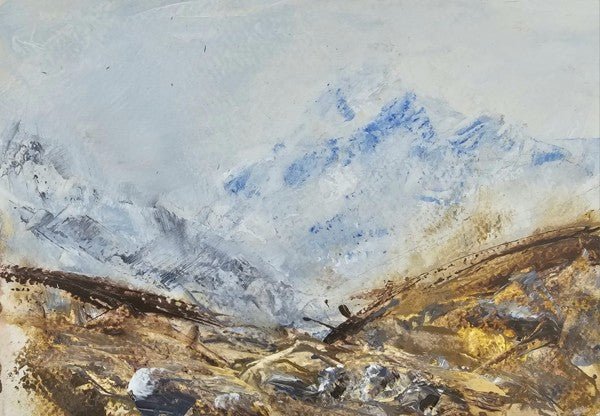
I have spent much of my life exploring New Zealand's mountains, coastlines and wild places. As both a climber and a painter, I have become less interested in simply describing a landscape and more interested in capturing its atmosphere - the movement of weather, the quality of light, and the feeling a place leaves behind.
For collectors searching for New Zealand landscape paintings for sale, that distinction matters. The strongest works are not souvenirs of scenery. They are interpretations of experience. A painting should do more than show a mountain or coastline. It should bring something of that place into the room.
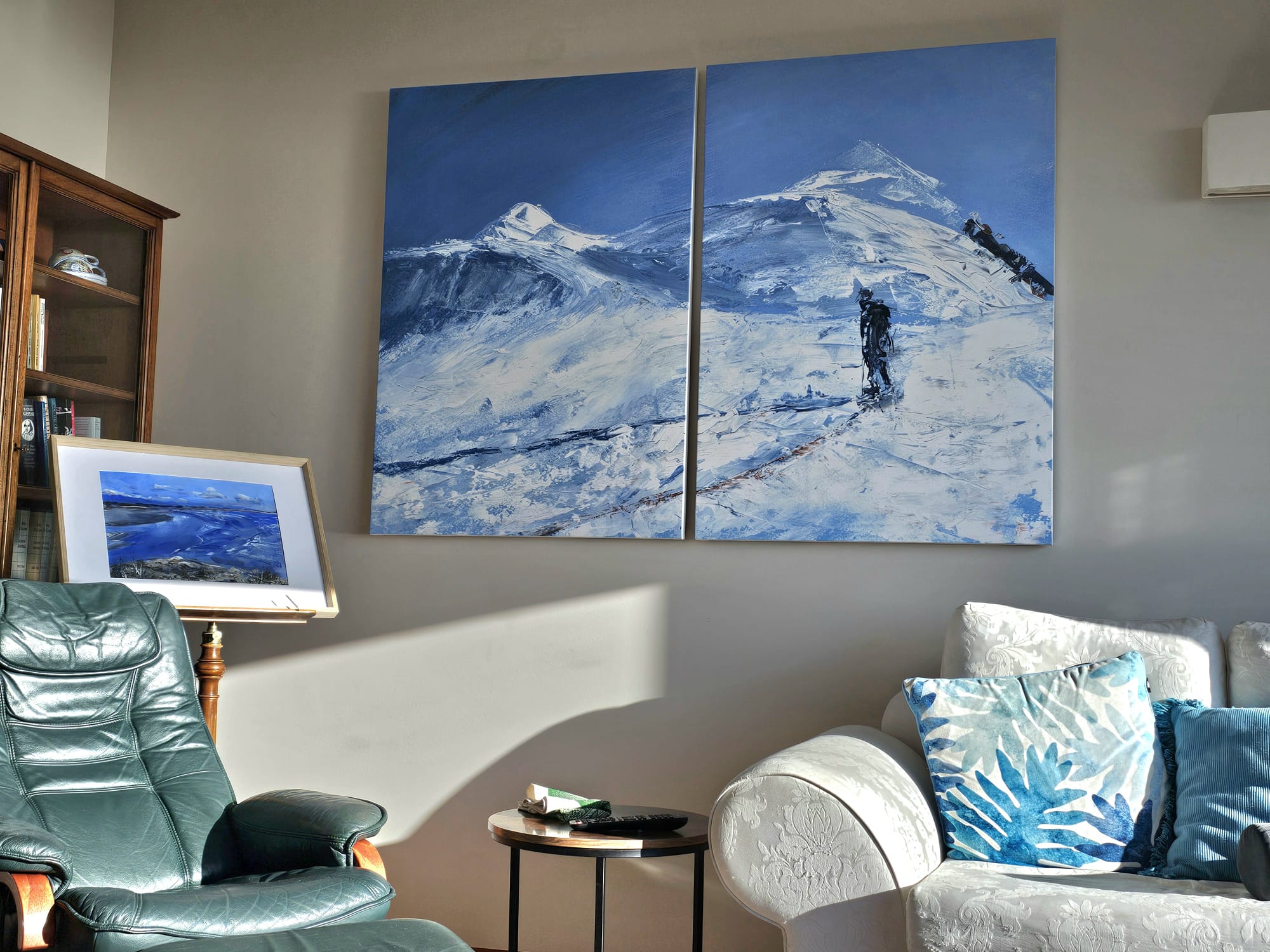
My work is available as both original paintings and large-format fine art canvas editions, allowing collectors to experience New Zealand landscapes at a scale that suits their home, lodge or architectural space.
What makes New Zealand landscape paintings worth collecting
The light here is like nowhere else on earth. It can turn hard and silver over alpine ground, then soften into a haze across water by late afternoon. In strong contemporary landscape painting, that light is not decorative. It shapes the entire emotional architecture of the work.
This is one reason New Zealand landscape paintings have such appeal for international buyers. They carry a rare mix of grandeur and intimacy. A painting might suggest vast distance, but it can also feel close - a remembered track, a passing storm, a hillside held in low cloud. That balance gives the work depth in a room. It does not shout. It stays.
Collectors are often drawn to New Zealand landscapes for personal reasons as well. Some have travelled here and want something more considered than photography can offer. Others have never visited but respond to the elemental clarity of the terrain. The appeal is not only geographic. It is emotional. These are paintings that often speak in quiet, precise ways.
New Zealand landscape paintings for sale - originals or prints?
That choice depends on what you want the artwork to do in your life and collection. An original painting carries the directness of the artist's hand. Surface variation, subtle shifts in pigment, moments of revision and pressure - these are part of its authority. For many collectors, an original is about proximity to the artist's actual process, and the singularity that comes with owning the one work in which those decisions reside.
A fine art canvas print offers something different, and not lesser when produced well. It allows buyers to live with a larger image, or with a particular work that has already sold in its original form. For interiors, scale matters. A print can create visual weight and atmosphere in a way a smaller original sometimes cannot. For first-time collectors, it can also be the point of entry into an artist's world.
For my own practice, large-format canvas works play an important role. Many landscapes are experienced through scale. A mountain range, a weather system or an expansive coastline can lose much of its impact when reduced to a modest size. High-quality canvas reproductions allow collectors to experience these works at architectural scale, creating a stronger sense of atmosphere and presence within a space.
In many contemporary homes, lodges and commercial interiors, a large-format work can become a defining element of the room. Rather than simply decorating a wall, it helps shape the character and emotional tone of the environment itself.
The trade-off is straightforward. Originals offer uniqueness and object value. Fine art canvas editions offer access, flexibility and often greater scale. The question is less about status than about intention. Are you building a collection around rarity, or choosing a piece that will define the feeling of a room? For many buyers, the answer changes over time.
How to judge quality when viewing New Zealand landscape paintings for sale
Start with presence. Before medium, dimensions or price, ask whether the painting holds your attention. Not for ten seconds, but for longer. The best landscape works keep opening. They resist instant consumption.
Then look at what the artist is actually doing with place. Is the painting merely reporting the scene, or has it been interpreted through a distinct visual language? Serious contemporary landscape painting does not rely on topographic accuracy alone. It edits. It compresses. It lets atmosphere carry meaning.
Colour is another quiet test. In weaker work, colour can feel borrowed from expectation - blue lake, green hill, white peak. In stronger work, colour behaves more truthfully to sensation. The land may be cooler, drier, darker or more luminous than memory expects. That confidence often signals an artist painting from experience rather than from formula.
Surface matters too, especially in original works. Acrylic on paper can carry remarkable immediacy when handled with restraint and conviction. You may notice areas of broken brushwork, thin passages beside denser marks, or soft transitions that suggest mist, rain or distance without over-describing them. These qualities are difficult to fake and impossible to fully reproduce through words alone.
Finally, consider coherence. Does the work sit within a clear practice? Artists worth collecting tend to return to certain questions - light, weather, edge, distance, movement, mood. You can feel when a painting belongs to an ongoing body of thought rather than being made to satisfy a market category.
The role of atmosphere in contemporary landscape art
There is a kind of landscape painting that gives you every detail and leaves you with nothing to feel. Atmospheric painting works the other way. It may withhold information, soften boundaries, or simplify form, but in doing so it creates a stronger sense of being there.
This is especially true of New Zealand. Much of its power lies in conditions that shift by the minute - rain moving across a valley, cloud pressing low over a ridge, sudden brightness on water. An artist committed to atmosphere paints not just landforms, but the instability and mood that make those places alive.
For collectors, this matters because atmosphere is what gives a painting longevity in a domestic or architectural space. Literal scenic work can date quickly. A painting rooted in mood tends to deepen with time. It meets different weather, different seasons, different states of mind. It remains active.
Buying for a room, or buying for a collection
These are not always the same decision. Interior designers and homeowners often begin with scale, palette and placement. They are asking how a work will live with timber, stone, linen, glazing, shadow. That is a legitimate way to buy art, provided the painting itself still has integrity. The right landscape can anchor a space without becoming background.
Collectors, meanwhile, may be more interested in continuity of practice, rarity, exhibition history, or where a work sits within an artist's development. They may tolerate a more difficult piece because it has stronger long-term significance. They are buying not only for present pleasure, but for dialogue with other works they own.
Most buyers sit somewhere between these poles. They want something visually commanding, but they also want substance. That is where contemporary New Zealand landscape painting has particular strength. At its best, it offers both. It can transform a room and still hold up under serious looking.
Why place-based painting still resonates
There is a reason paintings grounded in real places continue to matter, even in an image-saturated culture. They slow perception. They ask us to see land not as content, but as experience. A painted coastline or mountain is not only a picture of somewhere. It is evidence that someone stood there long enough to be altered by it.
That depth of relation is increasingly rare, and buyers recognise it. When an artist knows a region intimately, the work carries a different authority. The decisions feel earned. The painting is less about spectacular geography and more about familiarity, return, and the subtleties only repeated looking reveals.
This philosophy sits at the centre of my own practice. Many of my paintings begin with direct experience of New Zealand's alpine environments. I am less interested in describing a location exactly than in capturing its atmosphere - the shifting weather, changing light and sense of scale that make a place memorable. My aim is to create work that continues to reveal itself over time, both as a painting and as part of the space in which it lives.
What to look for before you enquire
If you are considering a purchase, spend time with the work first. Notice whether it still feels compelling after the initial attraction to subject matter. Ask yourself if you are responding to the place, or to the painting itself. The difference is worth understanding.
It is also sensible to consider scale honestly. A modest work can be exquisite, but if you need the painting to carry a large wall, intimacy alone may not be enough. Equally, a large print may offer the right visual impact where an original would feel too slight. There is no universal rule here, only fit.
And if you are buying as a collector, ask about edition structure, medium, support, and whether the work belongs to a particular collection. Context adds meaning. It helps you understand not only what you are acquiring, but why the work exists in the form it does.
The best landscape paintings do not simply show New Zealand. They bring its shifting light, exposed edges and deep weather into the room with them. Choose the work that continues to hold its atmosphere when the day changes around it.

Leave a comment
All comments are moderated before being published.
This site is protected by hCaptcha and the hCaptcha Privacy Policy and Terms of Service apply.